
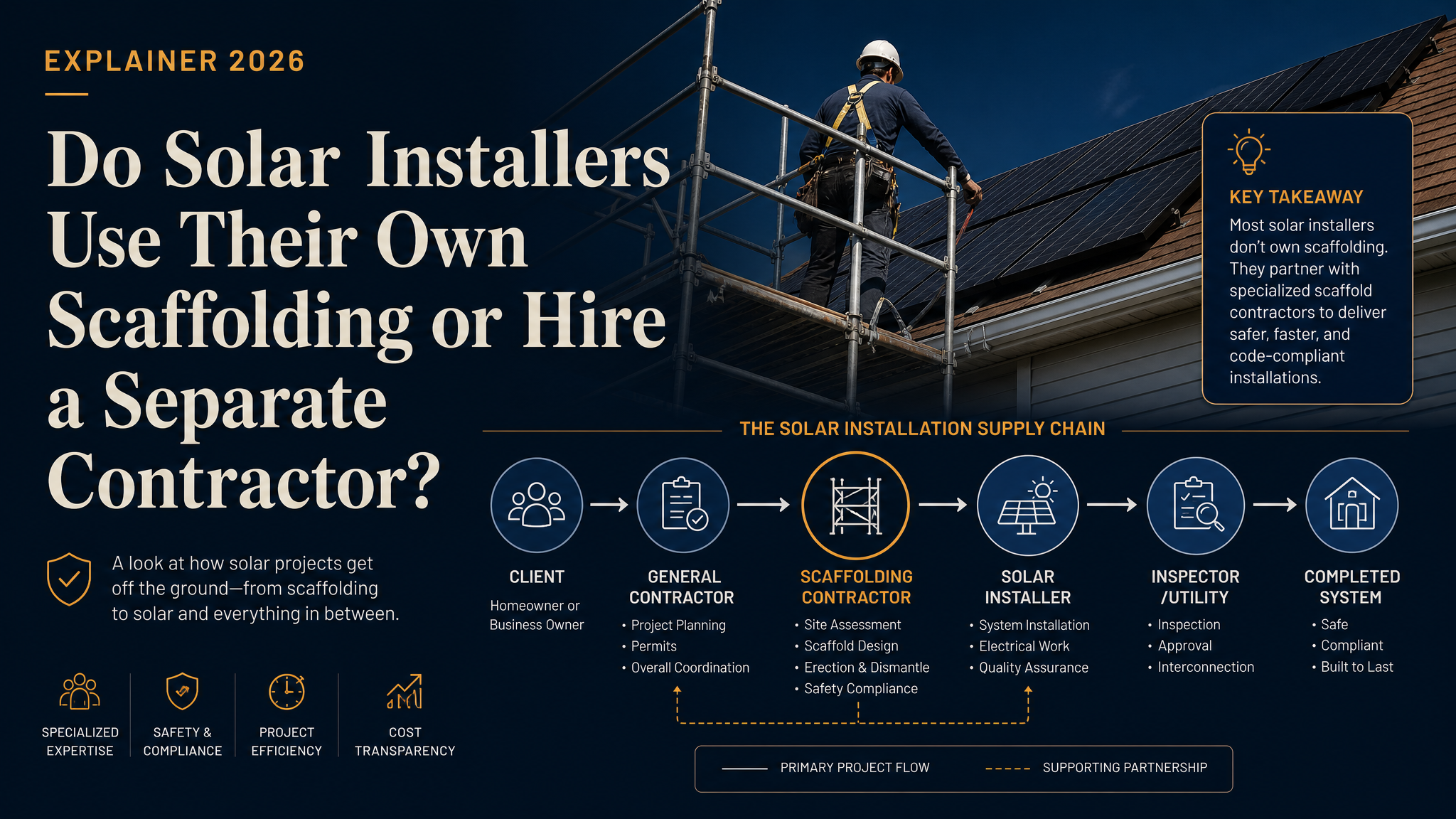
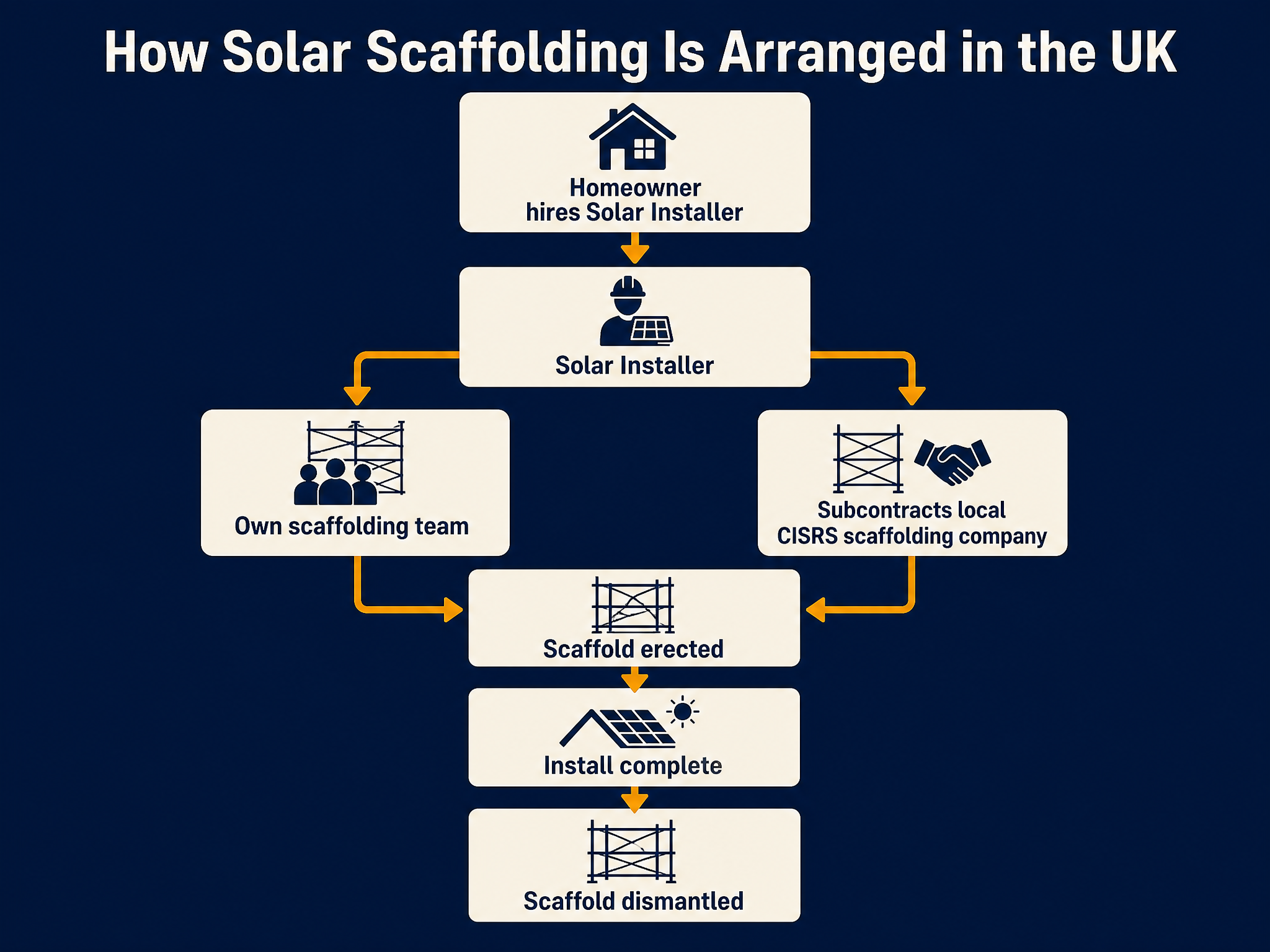
Short answer: Most solar installers subcontract scaffolding to a specialist CISRS-certified company. The key thing to check is that the installer can name the company, confirm CISRS credentials, and takes responsibility if the scaffold is delayed or wrong.
Key Takeaways
- Most solar installers subcontract scaffolding to a specialist — standard practice.
- Some larger national installers have in-house teams; most local installers use a trusted local scaffolder.
- Ask for the scaffold company's name and CISRS certification — that's the quality signal.
- The installer remains accountable to you — if scaffold is wrong, escalate to the installer.
- CISRS-certified operatives hold a valid CISRS card — copies available on request.
- Check the scaffold company holds public liability insurance of at least £5m.
Why do solar installers subcontract scaffolding?
Solar installation and scaffolding are distinct trades with different certification requirements. UK scaffolding is governed by CISRS (Construction Industry Scaffolders Record Scheme), and erecting scaffold professionally requires CISRS-qualified operatives. Solar installers are qualified in electrical systems and MCS certification — not scaffolding.
As Contact Solar put it: "9 times out of 10, the company that puts the scaffolding up is a sub-contractor to the solar panel installer." It's the same model as most construction trades — a main contractor coordinates specialist subcontractors. Efficient and normal.
What should you check when your installer subcontracts scaffolding?
| What to check | How to check it | Why it matters |
|---|---|---|
| Scaffolding company name | Ask the installer directly | Confirms a real contractor is in place |
| CISRS certification | Ask for CISRS card copies | Required for compliant scaffold under TG20:21 |
| Public liability insurance | Request certificate — min £5m, ideally £10m | Covers damage or injury |
| Responsibility for delay/error | Confirm in writing that installer is accountable | Prevents disputes about who to call |
| Dismantle included in fixed price | Confirm in quote document | Some installers leave dismantle costs unspecified |
What if the scaffold subcontractor makes an error?
Your contract is with the solar installer — not the scaffold company. If the scaffold is erected late, incorrectly, or doesn't meet the installation spec, your point of contact is the installer. They are responsible for managing their subcontractors.
If the installer refuses to accept responsibility, escalate via the Renewable Energy Consumer Code (RECC) if they are a member, or through the Consumer Rights Act 2015.
Frequently asked questions
Do solar panel installers use their own scaffolding or hire a separate company?
In most cases, solar installers subcontract scaffolding to a specialist scaffold company. This is standard practice. Some larger national installers have in-house scaffold teams, but most regional and local installers arrange scaffolding through a trusted subcontractor.
Is it a problem if my solar installer subcontracts the scaffolding?
No — it's normal practice and doesn't affect quality, provided the subcontractor is CISRS-certified and the installer takes responsibility for coordinating the scaffold spec. The practical thing to check is that the installer can name the scaffold company and confirm their CISRS credentials.
What should I check if my solar installer subcontracts scaffolding?
Ask for the scaffold company's name. Ask whether their operatives are CISRS-certified. Request their public liability insurance certificate (minimum £5m, ideally £10m). Ask who is responsible if the scaffold is delayed or doesn't meet spec. And confirm the installer includes scaffold dismantle in the fixed price.
Can my solar installer recommend a local scaffold company I can book directly?
Some will; some won't. Larger installers prefer to manage the scaffold themselves for accountability reasons. Smaller local installers often have a preferred local scaffolder they work with and may suggest them. If you want to book directly, ask explicitly.
What happens if the scaffold subcontractor makes an error?
If the scaffold is erected incorrectly or does not meet spec, the solar installer is responsible for managing the correction — they contracted the scaffolder and are accountable to you. Escalate to the installer in writing if there is a scaffold problem. If the installer is MCS-certified, RECC dispute resolution is available.
Is there a difference between an installer's in-house scaffold team and a subcontractor?
In practice, not much — provided both hold CISRS certification. An in-house team may have better familiarity with the installer's specific setup requirements. A good subcontractor who regularly works with the installer has the same institutional knowledge. CISRS certification is the quality signal to check, not employment status.