
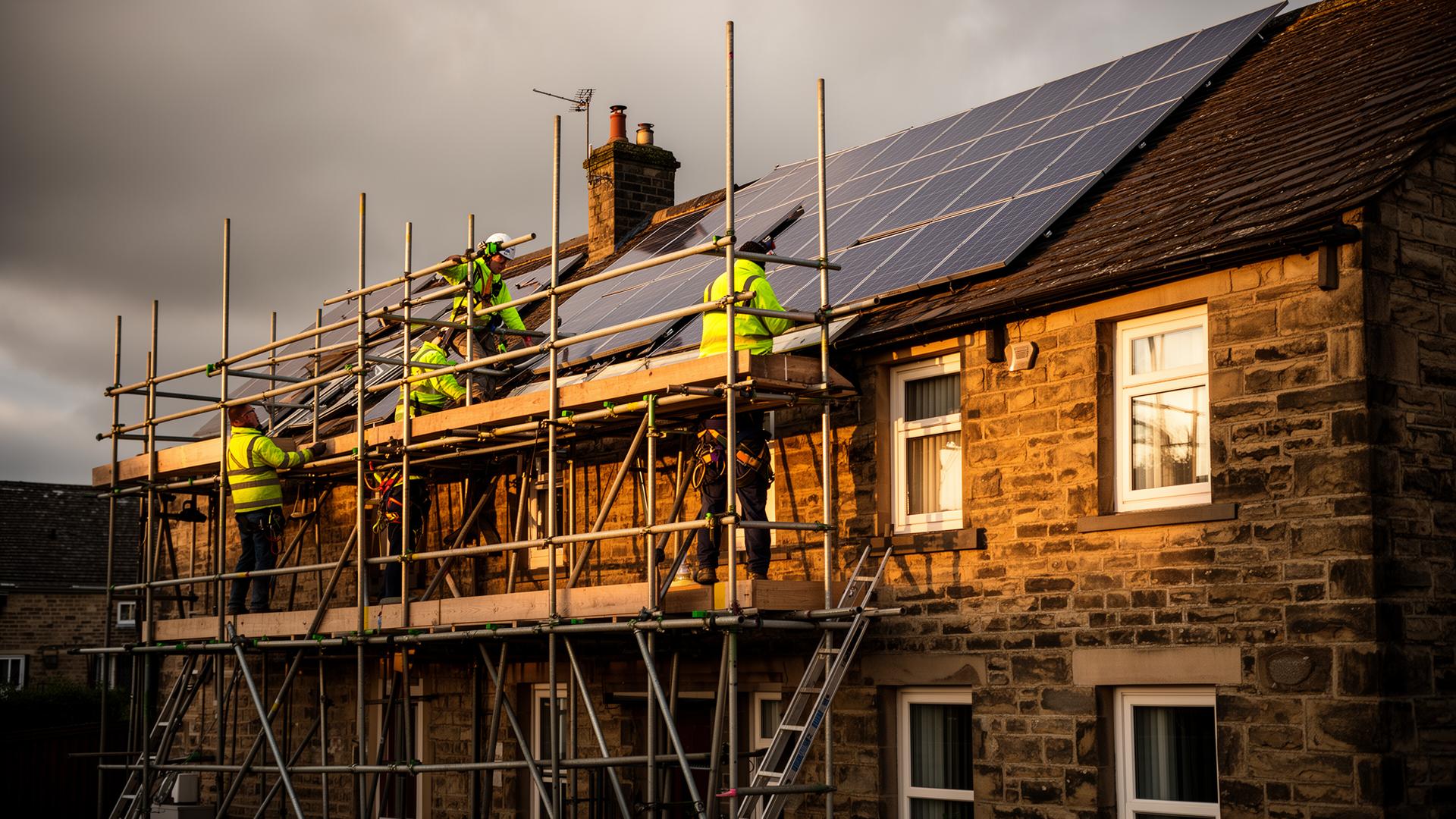
How much does solar panel scaffolding cost? — In Lancashire and the North West, most domestic solar installs cost between £350 and £800 for scaffolding in 2026, depending on property size and access. A mid-terrace typically falls at the lower end; a large detached at the higher. One week's hire is included in most quotes.
Key Takeaways
- Lancashire solar scaffolding: £350–£500 for a mid-terrace, £450–£650 for a semi-detached, £550–£800 for a detached home (NW Scaffold Co, 2026)
- Nationally, scaffolding accounts for approximately 13% of total solar installation cost
- Scaffolding is legally required on pitched roofs under the Work at Height Regulations 2005
- The UK recorded 257,397 MCS-certified solar installations in 2025 — a 32% year-on-year increase and the highest annual total ever recorded
- Standard hire is one week — most domestic installs complete in 3–5 days on-site
- Hire extensions should be charged at a flat weekly rate (£40–£80 in Lancashire) — not per day
- Always confirm scaffolding is included in your solar quote before signing — some installers price it separately
How much does solar panel scaffolding cost in Lancashire?
The most reliable way to understand solar scaffolding costs is by property type. Here are the prices we charge at NW Scaffold Co for standard domestic solar installs across Lancashire and the North West in 2026.
| Property type | Price range | Hire included | Notes |
|---|---|---|---|
| Mid-terrace (single elevation) | £350–£500 | 1 week | Standard front-only scaffold. Most straightforward solar job. |
| Semi-detached (single elevation) | £450–£650 | 1 week | Slightly longer run. Access usually straightforward. |
| Detached (single elevation) | £550–£800 | 1 week | Larger footprint. Open access keeps costs controlled. |
| Wraparound / two elevations | £900–£1,400 | 1–2 weeks | Required for larger arrays or awkward roof configurations. |
| Three-storey or complex access | Quoted individually | Agreed per job | Site visit required. Listed-building constraints, conservatories, steep gardens. |
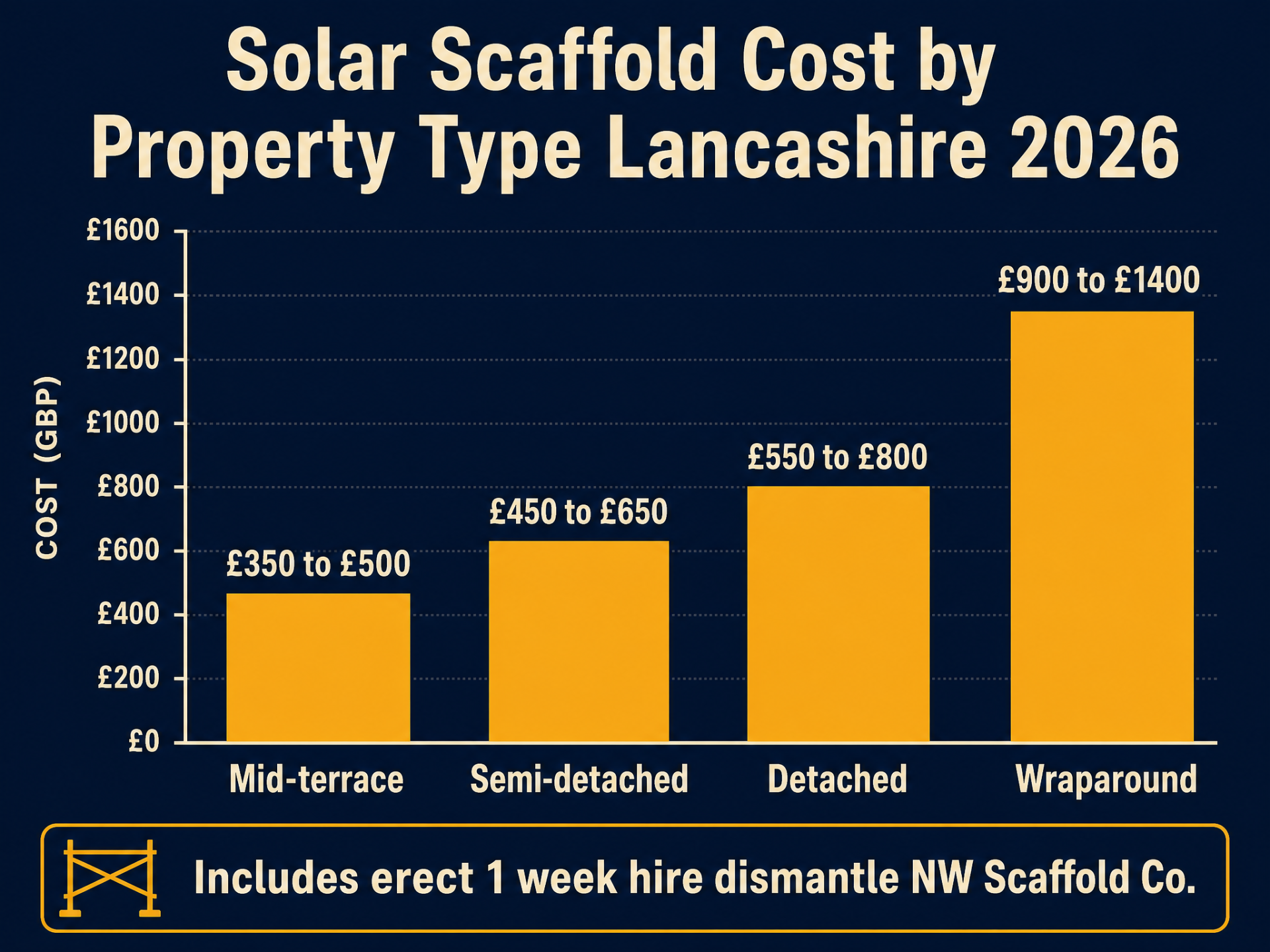
All prices include erection, one week's hire, edge protection, sign-tagging, public liability insurance documentation, and dismantle. Lancashire pricing is typically 10–15% lower than London and the South East, where higher labour costs and congestion charge zones push rates up.
Price your own scaffold in 60 seconds
Skip the ranges. Enter your measurements and get an instant figure tailored to your property.
Side to side
≈ 3m per storey
Solar installs typically need 1–2 weeks. Price starts at 1 week; each extra week adds ~5% of the base.
What affects the cost of solar panel scaffolding?
The base price covers a standard single-elevation scaffold on a two-storey property with reasonable access. Several factors can move the quote up or down.
Property height
The single biggest cost driver. Three-storey properties need taller scaffold lifts, more tube, and more time to erect safely.
Access difficulty
Terraced houses with narrow side passages, steep gardens, or road access restrictions all add time and complexity — and cost.
Number of elevations
A front-only scaffold for a standard solar job is straightforward. Wraparound or rear-elevation access roughly doubles material and erection time.
Pavement licence
If the scaffold extends over a public pavement, a licence from the local council is required. Costs and lead times vary by borough.
Hire duration
Standard is one week. DNO delays, bad weather, or rescheduled install dates can mean extensions. Flat weekly extension rates keep this predictable.
Conservatories & obstacles
Overhanging trees, rear conservatories, satellite dishes, and listed-building constraints can all require modified scaffold designs.
Nationally, scaffolding typically accounts for around 13% of the total cost of a solar panel installation. On a standard domestic system, that makes scaffolding the most significant fixed cost after the panels and inverter themselves.
What's included in a solar scaffolding quote — and what isn't?
A properly scoped quote for solar panel scaffolding should include:
- Erection — the crew visiting, setting up the scaffold to CISRS and NASC specification
- Hire period — one week as standard for most domestic jobs
- Edge protection — guard rails and toe boards at the eaves and ridge where required
- Sign-tagging — the Scafftag certifying the scaffold is safe for the installer to use
- Public liability insurance — £10m as a minimum; certificates available on request
- Dismantle — returning to strike the scaffold once installation is complete
Watch out for quotes that separate out daily hire rates. A quote showing "erect: £300 + £35/day hire" can sound cheaper than a £500 fixed-price quote — but a two-week install at £35/day adds £490 in hire alone, putting you well over the fixed price before any overrun.
Do you actually need scaffolding to install solar panels?
For pitched roof installations in the UK — which covers the overwhelming majority of domestic solar — yes, scaffolding is required by law. The Work at Height Regulations 2005 require employers and self-employed contractors to provide collective fall protection whenever work is carried out at height where a fall could cause injury.
Working from ladders is not adequate for solar installation. Ladders do not provide a stable platform for carrying panels (typically 2.2m × 1.1m and made of glass), connecting roof brackets, or the electrical work that follows. The scaffold platform must be positioned less than 400mm below the bottom edge of the roof to allow safe access to the installation area.
Any MCS-certified installer — the accreditation required for solar installations to qualify for Smart Export Guarantee payments — will require scaffolding before starting. If a quote comes in significantly lower because it omits scaffolding, that is a warning sign, not a saving.
"Scaffolding should always be installed by qualified professionals and fully compliant with safety regulations — cutting corners puts workers and homeowners at risk."— Industry guidance, UK scaffolding sector
How long does solar scaffolding stay up — and what do hire extensions cost?
Most domestic solar installs are a one- or two-day job for the panel crew. We typically erect the scaffold the day before the install and dismantle the day after sign-off — so total on-site time is usually 3–5 days. Our quotes include one week's hire as standard, which comfortably covers this with a buffer. For more detail on timing, see our full guide on how long solar panel scaffolding stays up.
If the install overruns — DNO connection delays are the most common cause in Lancashire — extensions are available at a flat weekly rate:
| Scenario | Extension cost (Lancashire) |
|---|---|
| Small domestic job overrun | £40–£60/week |
| Mid-size detached overrun | £60–£80/week |
| Commercial or wraparound | Quoted individually |
The scaffold window is also a good opportunity to get other work done. Many homeowners use the same hire period to tackle gutter cleaning, chimney repointing, fascia replacement, or render repairs — one scaffold visit, multiple jobs. Tell us upfront and we'll price the extended hire into the original quote.
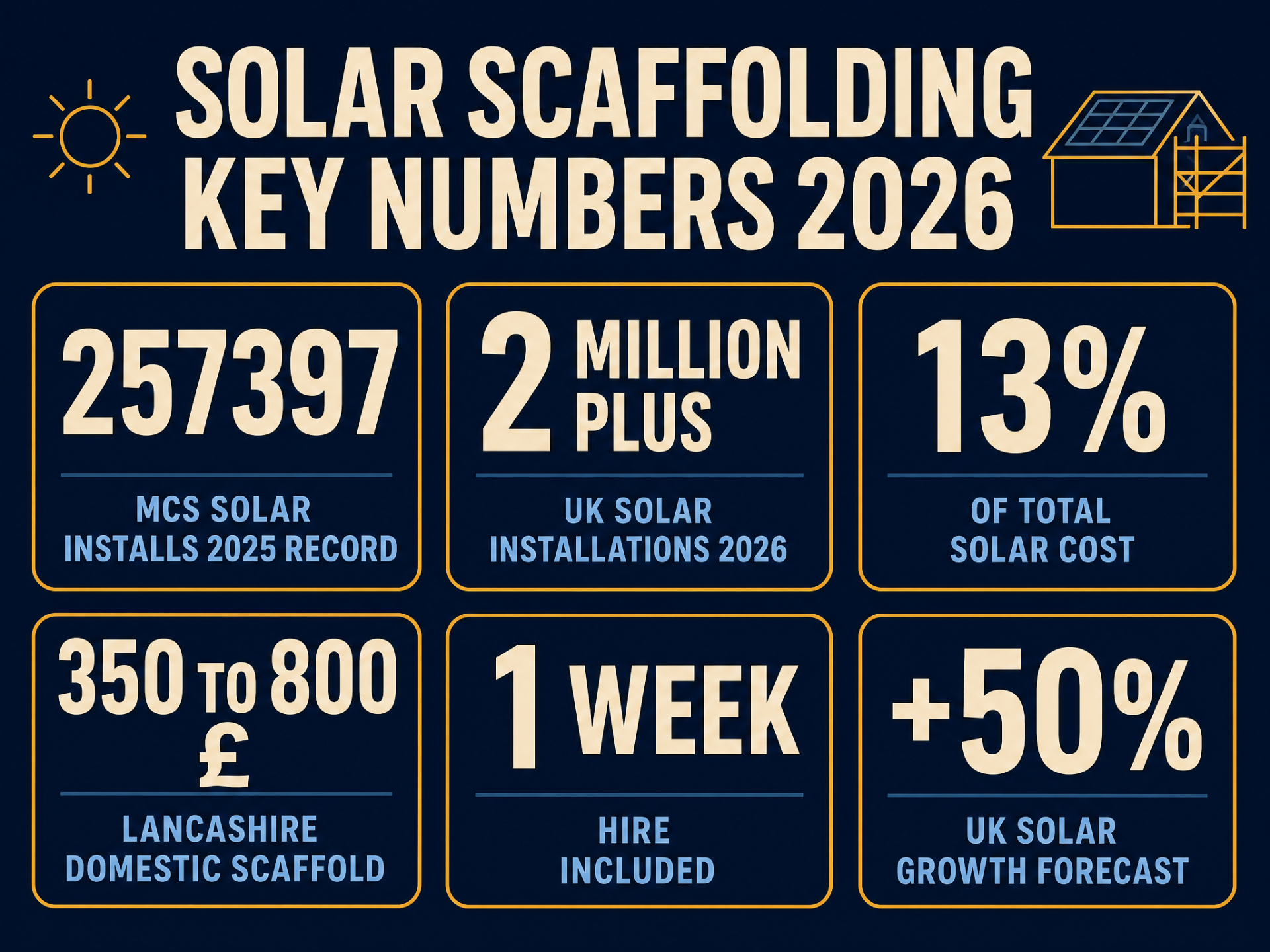
Key numbers: solar scaffolding and the UK solar boom
How does Lancashire pricing compare to the UK average?
Lancashire and the North West sit in the mid-range to lower end of the UK pricing spectrum for scaffold. London and the South East — where labour costs are higher and congestion or pavement licensing adds administrative overheads — typically run 20–30% above Lancashire rates for equivalent jobs.
| Region | Typical semi-detached solar scaffold | vs Lancashire |
|---|---|---|
| Lancashire / North West | £450–£650 | Baseline |
| Yorkshire / East Midlands | £480–£700 | ~5–10% higher |
| South East (excl. London) | £550–£800 | ~15–25% higher |
| Greater London | £650–£950+ | ~30–45% higher |
If you're in BB, PR, BD, or BL postcodes, scroll up to use the inline calculator for an instant ballpark — or see our standalone scaffolding cost calculator.
How to get an accurate solar scaffolding quote
The fastest route to a fixed price is to send four pieces of information to a scaffolding contractor:
- Your postcode — so we can assess access, pavement licence requirements, and local crew availability
- Property type and number of storeys — terrace, semi, detached, flat, or other
- Which elevation needs access — front, rear, side, or wraparound
- The install date — so we can align scaffold up and scaffold down with your installer's schedule
With that information, we can confirm a fixed price within one working day. For trade partners — solar installation companies across Burnley, Blackburn, and the rest of Lancashire — we offer trade rates and next-day availability. See our solar installer partner programme for details.
Frequently asked questions about solar panel scaffolding costs
How much does solar panel scaffolding cost in the UK?
Solar panel scaffolding costs between £300 and £1,000 for most UK domestic properties. In Lancashire and the North West, a mid-terrace typically costs £350–£500, a semi-detached £450–£650, and a detached home £550–£800. Prices include erect, one week's hire, and dismantle. London and the South East run 20–30% higher due to labour and licensing costs.
Is scaffolding always necessary for solar panel installation?
For pitched roof installations, yes. The Work at Height Regulations 2005 require safe collective fall protection for anyone working on a sloping or elevated roof. Any reputable, MCS-certified installer will require scaffolding before starting work. Flat roof commercial installations may use alternative access systems, but domestic solar on a pitched roof needs scaffold.
What is typically included in a solar scaffolding quote?
A proper quote includes erection, one week's hire, edge protection, sign-tagging, public liability insurance documentation, and dismantle. Watch out for quotes that price hire per day rather than per week — that's how unexpected costs creep in. A £300 erection cost plus £35/day hire will exceed a £500 fixed-price quote in less than a week.
How long does solar panel scaffolding stay up?
Most domestic solar installs take one to two days for the panel crew. Scaffolding is typically erected the day before, giving a total on-site period of 3–5 days. Standard quotes include one week's hire, which covers most jobs with a buffer.
What happens if the install overruns and I need the scaffold longer?
A good scaffolding contractor extends at a flat weekly rate — typically £40–£80 in Lancashire depending on job size. Avoid contractors who charge per day for extensions — costs escalate quickly if a DNO connection is delayed or bad weather pushes the install back. Let your contractor know as soon as you hear of a delay; we hold the scaffold without any rush to dismantle.
Why is scaffolding for a terraced house sometimes more expensive?
Terraced houses often have restricted access — narrow passages, shared entries, or limited road access for the van and materials. This increases labour time and complexity, which can push the quote toward the higher end of the range. Town-centre terraces that require a pavement licence add a further fixed cost from the local council.
Can I use the scaffold for other work at the same time?
Yes, and it often makes financial sense to do so. Gutter cleaning, chimney repointing, fascia repairs, or render touch-ups can all be done during the same hire window. Tell the scaffolding contractor upfront so they can price any extra hire time into the original quote, rather than you paying for a second scaffold visit later.
Does solar scaffolding cost more in Lancashire than elsewhere in the UK?
No — Lancashire and the North West typically cost less than London and the South East, where labour and congestion charges push prices higher. Lancashire pricing is broadly in line with national mid-range estimates from comparison sites. The price you'll see from us reflects regional rates, not inflated national averages.
Written by NW Scaffold Co
CISRS-certified scaffolding contractors based in Brierfield, Lancashire — with over 12 years of experience erecting scaffold for solar installers, builders, and homeowners across the North West. Around 60% of our current work is solar. About us →