
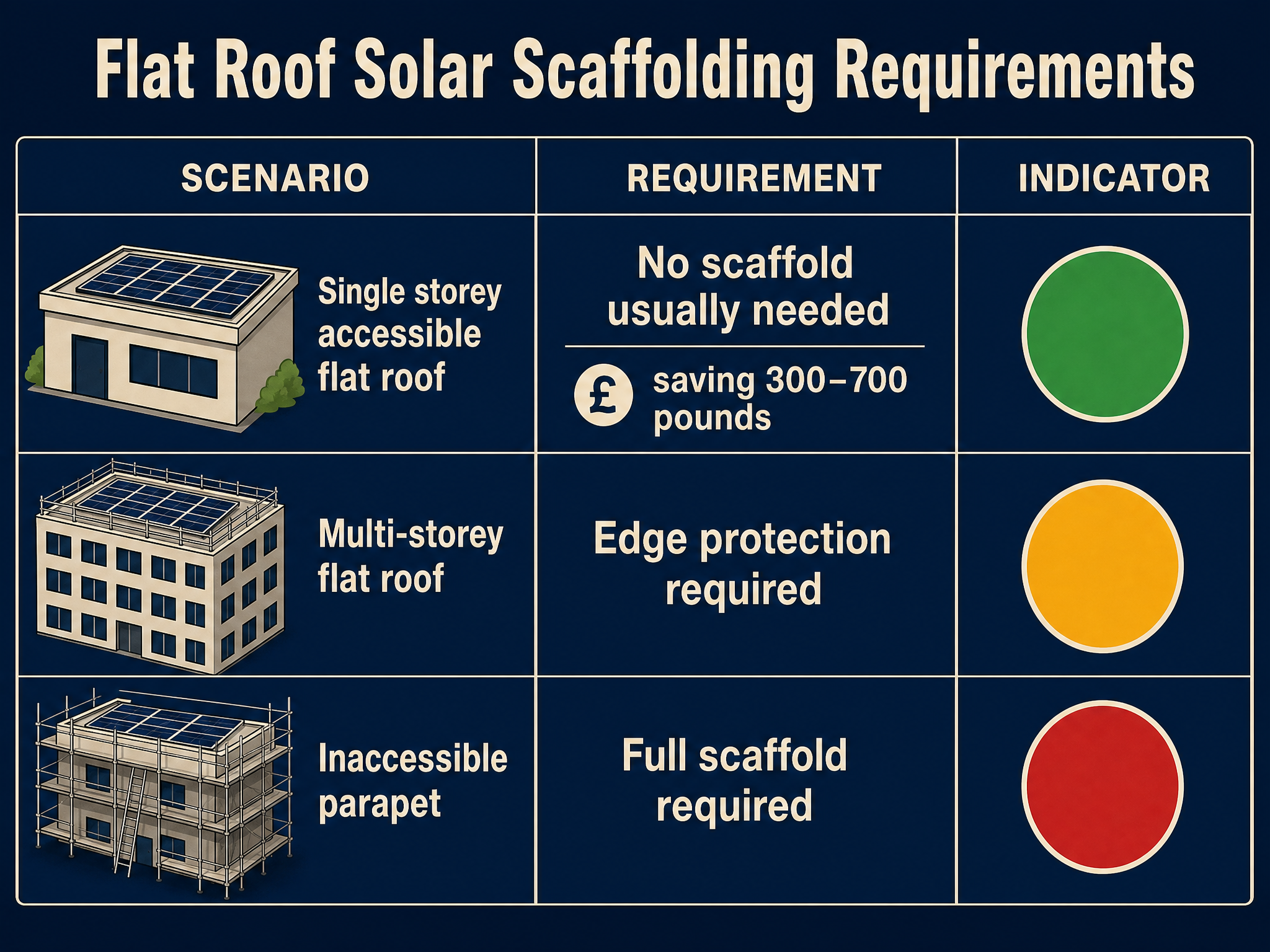
Short answer: Not always. A single-storey accessible flat roof (garage, extension) often needs no scaffold, saving £300-£700. Multi-storey flat roofs still require scaffolding or equivalent fall protection under the Work at Height Regulations 2005.
Key Takeaways
- Single-storey accessible flat roofs often need no scaffold — saving £300-£700.
- Multi-storey flat roofs still require edge protection or scaffold.
- Government removed planning permission for flat roof solar in November 2023.
- Work at Height Regulations 2005 apply to all roofs above 2 metres.
- A single-storey flat roof with a high enough parapet wall may qualify as protected.
- Your installer should perform a risk assessment and tell you before the install date.
Is a flat roof accessible enough to skip scaffolding?
| Flat roof type | Scaffold needed? | Typical additional cost |
|---|---|---|
| Single-storey extension or garage (accessible) | Usually no | Saving of £300-£700 vs pitched |
| Single-storey with low parapet | Edge protection required | £150-£300 for temporary edge protection |
| First-floor flat roof (above 2 m) | Edge protection or scaffold required | £300-£600 depending on configuration |
| Multi-storey flat roof | Full scaffold required | Same as standard commercial solar scaffold |
When does a flat roof still need scaffolding?
Even on a flat roof, scaffolding or equivalent collective fall protection is required in these scenarios:
- Roof above 2 metres without adequate parapet — Work at Height Regulations require protection
- No safe direct access route — if climbing over gutters or through windows is the only option
- Roof condition unknown — any doubt about structural integrity means a scaffold platform is needed
What is temporary edge protection — and is it cheaper than scaffold?
For flat roofs that need edge protection but not full scaffolding, freestanding temporary edge protection systems (guardrails on weighted bases) provide a legal alternative. They are:
- Faster to install (hours, not days)
- Cheaper than full scaffold (£150-£400 vs £400-£800)
- Still fully compliant with Work at Height Regulations
- Sometimes managed by the solar installer rather than a separate scaffolder
Frequently asked questions
Does a flat roof need scaffolding for solar panels?
It depends on whether the flat roof is accessible and at what height. A single-storey accessible flat roof (like a garage or extension) often needs no scaffold — saving £300-£700. Multi-storey flat roofs or those with no safe internal access route do require scaffold or equivalent fall protection.
How much money can I save on scaffolding with flat roof solar panels?
If the flat roof is accessible without scaffold, you save £300-£700 on scaffold costs — the amount that would otherwise be added for a standard domestic solar scaffold. Some installers specifically market flat roof solar as cheaper partly because of this saving.
What makes a flat roof accessible for solar installation without scaffold?
A roof is considered accessible if: it is single-storey with direct ladder access, the parapet wall is sufficient height to act as fall protection, or there is safe internal stair access to the roof. The installer performs a risk assessment to confirm. If any doubt exists, scaffold or equivalent edge protection is required.
What edge protection is needed for flat roof solar installation?
If the flat roof is above 2 metres and lacks a parapet of adequate height, edge protection must be installed. This can be temporary freestanding edge protection (rails, uprights) rather than full scaffolding — lighter and cheaper, but still required under Work at Height Regulations 2005.
Do solar panels on a flat roof extension need scaffolding?
Usually not — single-storey flat roof extensions are typically accessible and at low height. However, if access to the extension roof is awkward (e.g. only accessible from a window or climbing over the gutter), a scaffold platform may still be needed. The installer should assess on site.
Can I get solar panels on a first-floor flat roof without scaffolding?
A first-floor flat roof is above 2 metres, which triggers Work at Height Regulations. Full scaffolding may not be required if adequate edge protection is installed, but some form of collective fall protection is always needed. The exact solution depends on the roof configuration and your installer's risk assessment.