
Short answer: It depends on who caused the delay. Installer-caused delays should be the installer's cost. DNO delays (G99 approval taking 4-8 weeks in 2026) are usually third-party events. The key protection is a contract clause agreeing extension terms upfront — and never erecting scaffold until a confirmed install date exists.
Key Takeaways
- Scaffolding should only go up once a confirmed install date exists — not during DNO waiting periods.
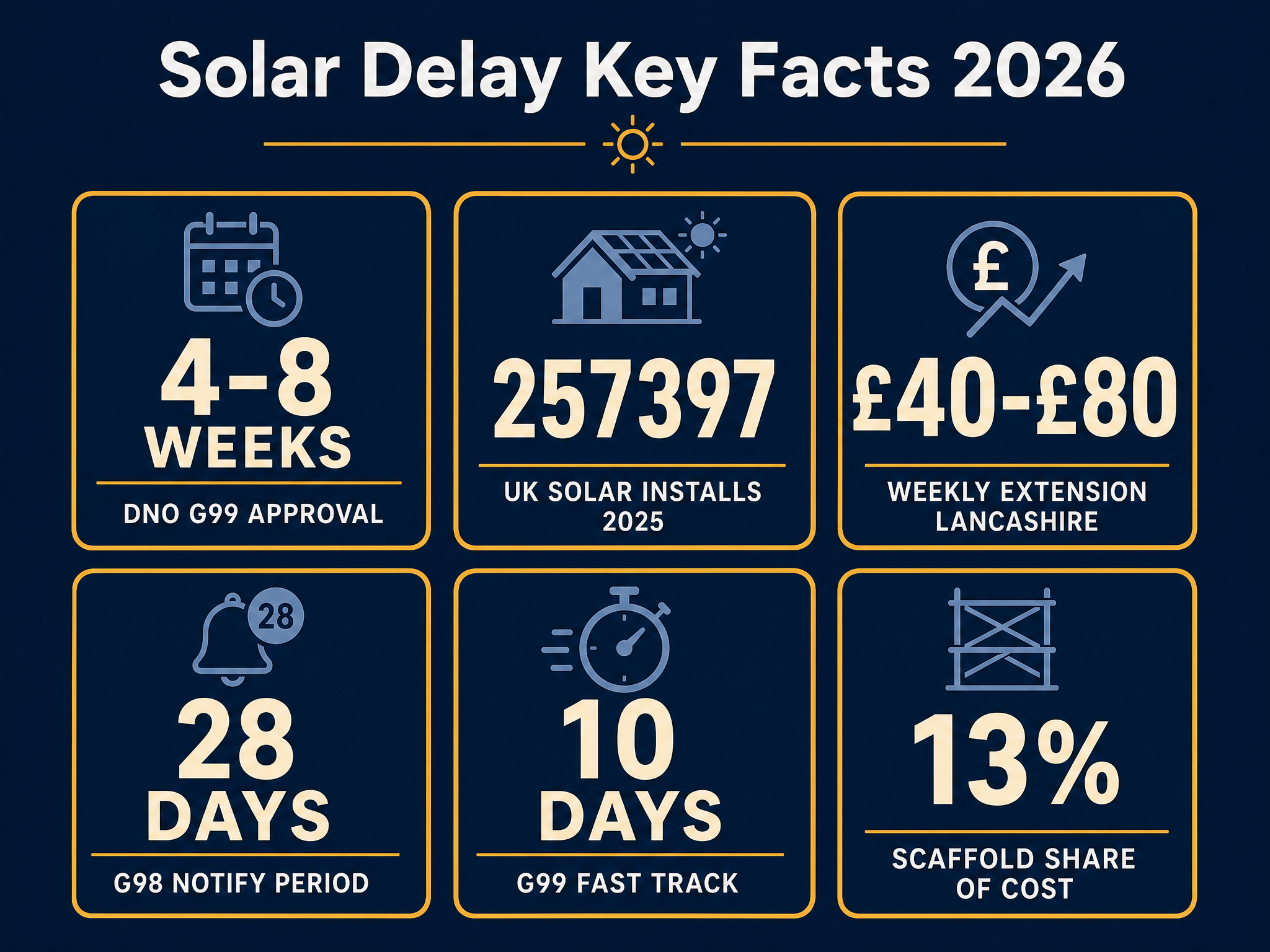
- G99 approval takes 4-8 weeks in 2026 due to record MCS-certified install volumes in 2025.
- Hire extensions should be at a flat weekly rate (£40-£80 in Lancashire) — not per-day.
- Agree who covers extension costs in writing before signing your solar contract.
- If the installer causes the delay, escalate via RECC for free dispute resolution.
- G98 systems (under 3.68kW per phase) need no pre-approval — DNO is notified within 28 days post-install.
Why do solar installations get delayed — and what does it mean for scaffolding?
Most solar delays fall into one of four categories. Each has a different implication for who carries the extension cost.
| Delay cause | Responsible party | What to do |
|---|---|---|
| G99 DNO approval wait | Third party (DNO) | Never erect scaffold until G99 is granted and a date is confirmed. This wait is not a scaffold hire issue. |
| Installer crew unavailability | Installer | Installer should cover extension costs. Get this in your contract before signing. |
| Weather postponement | Force majeure | Usually neither party's fault. One-week standard hire covers 2-3 day delays with buffer. |
| Kit/inverter delivery failure | Installer/supplier | Installer is accountable for their supply chain. Request written confirmation of cover. |
| Homeowner rescheduling | Homeowner | Extension costs fall on you. Give maximum notice to keep costs down. |
How does G99 DNO approval affect scaffold timing?
For most modern domestic solar systems — particularly those with battery storage — G99 approval is required before grid connection. In 2026, with UK rooftop solar installations hitting record volumes, DNO application queues have lengthened considerably.
The standard G99 process takes 4-8 weeks. The G99 Fast Track (for systems up to 7.36kW, 32A) offers a 10-working-day window. G98 systems (under 3.68kW per phase) bypass this entirely — install proceeds and the DNO is notified within 28 days.
What should your solar contract say about scaffolding extensions?
Before signing, ask for these clauses explicitly:
- Extension rate: Flat weekly, not per-day. Request the specific rate in writing.
- Delay responsibility: Which party covers extensions for DNO delays, weather, and installer-caused delays — each defined separately.
- Maximum idle period: If the install slips beyond a set number of weeks, scaffold is dismantled and re-erected when dates are confirmed.
- Notification obligation: Either party must notify the other (and the scaffolding contractor) within 24 hours of a known delay.
For more on what to push installers on before signing, see our 8 questions to ask about scaffolding in a solar quote and is scaffolding included in your solar quote?
What are your rights if the installer causes the delay?
Under the Consumer Rights Act 2015, services must be carried out with reasonable care and skill within a reasonable time. If the installer causes an unreasonable delay, you can request they cover extension costs in writing. If they refuse, RECC (Renewable Energy Consumer Code) offers free alternative dispute resolution for complaints against member installers.
Frequently asked questions
Who pays for extra scaffolding hire if my solar install is delayed by the DNO?
This depends on your contract. DNO delays are typically treated as third-party events outside the installer's control. Installer-caused delays should be the installer's responsibility. The fix is to agree extension terms in writing before work starts.
How long does G99 DNO approval take in 2026?
Standard G99 review takes 4-8 weeks in 2026 due to record demand. The G99 Fast Track (for systems up to 7.36kW) offers a 10-working-day window. G98 systems (under 3.68kW per phase) need no pre-approval.
What should my contract say about scaffolding extension costs?
Look for: flat weekly extension rate (not daily), which party covers DNO-delay extensions, maximum idle period before scaffold is dismantled and re-erected, and who contacts the scaffolding company if dates change.
What is the typical hire extension rate in Lancashire?
NW Scaffold Co charges £40-£80 per week flat rate depending on job size. Avoid per-day pricing — at £35/day, a two-week overrun costs £490 vs £80 on a flat weekly rate.
Can I get compensation if my installer causes the delay?
Yes. If the delay is within the installer's control, you have recourse under the Consumer Rights Act 2015. MCS-certified installers are also bound by the Renewable Energy Consumer Code (RECC) which offers free dispute resolution.
When should scaffolding go up relative to the install date?
Scaffolding should be erected the day before the installation crew arrives — not weeks in advance during the DNO waiting period. Only erect once you have a confirmed installation date from your solar installer.